Make it last
How to Care for Leather Shoes So They Last a Decade
Cedar trees every wear, cream then wax, salt treated the same week. Suede is a different animal. A welted pair is a resole, not a eulogy.
Updated 3 Jun 2026 · 8 min read · how to care for leather shoes
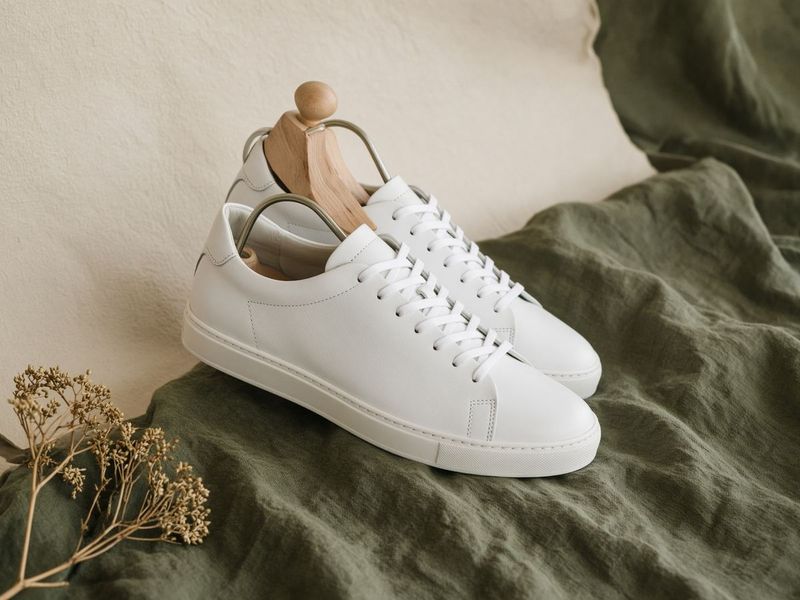
Cedar trees, every wear
A shoe tree is a last-shaped piece of cedar that goes in while the leather is still warm. It pulls moisture, holds the vamp from collapsing, and keeps the heel from folding into a permanent crease. Wear the shoes, tree them, wait a day, wear them again. Rotating two pairs doubles the life of both.
Buy proper split-toe cedar trees, $25–45 a pair, matched roughly to size. The $8 spring-loaded plastic trees do not absorb anything and can stretch the throat. Cheap unshaped cedar blocks are slightly better than nothing and much worse than a last. If you own one pair of oxfords or derbies worth keeping, the trees are not optional accessories. They are the maintenance.
Cream first, wax second
Cream polish is oil, pigment, and a little wax in an emulsion. It feeds the leather and evens color. Wax paste is mostly wax; it sits on the surface as shine and rain-shed. Cream into the leather with a cloth, let it sit, brush it. Then a thin wax on the toe, heel, and welt if you want water resistance. Wax on the vamp flex line will crack. Cream there, always.
Saphir Médaille d’Or cream is about $20 a tin and lasts a year of weekly use. Kiwi is $5–7 and is fine on a work shoe you already own. You do not need a $90 “heritage” kit to start. Horsehair brush $12–18. That is the whole bench.
| Cream | Wax paste | |
|---|---|---|
| What it is | Conditioner plus pigment | Surface wax, high shine |
| Where | Whole upper, especially flex | Toe, heel, maybe welt |
| On suede / nubuck | Never | Never |
| Frequency | 2–4 times a year | As needed for weather and shine |
| Price, honest tin | $6 Kiwi to $20 Saphir | $8–18 |
Salt stains, water, and when to resole
Winter salt leaves a white tide line and then dries the leather until it cracks. Wipe the shoe damp the day you get home. If the tide is already there, 1:1 white vinegar and water on a cloth, then a cream the same evening. Do not park them on a radiator. Heat plus salt is how a $300 calf oxford dies in one January.
Resoling is for welted construction — Goodyear welt, Blake, or Norwegian. When the rubber or leather outsole is worn through and you have not worn into the midsole or the welt stitching, a cobbler can take the sole off and put a new one on for $80–150. A $280 pair that takes three resoles over twelve years is a cheaper habit than a $90 cemented fashion shoe every 18 months. Cemented shoes (most sneakers, most fashion boots under $150) are not worth a resole; the factory glued the sole to the upper and there is nothing to stitch to.
Skip anything stamped genuine leather if you want this math to work. That grade is a corrected split; it does not take cream the same way, and cobblers will often refuse it. PU vegan leather cannot be conditioned back from a crack. Buy the hide, or accept the replacement cycle.
Suede is a different animal
Suede is the underside of the hide with a nap. Cream fills the nap. Wax kills it. Care is a suede brush (brass or crepe, $10–15), a gum eraser for dark spots, and a protector spray (Saphir Super Invulner or a fluorocarbon-free equivalent) applied when the shoe is new and reapplied after a soak. Water stains even out only if you dampen the whole panel, not if you dab the spot.
The same nap logic applies to a suede bag — the method in how to clean a leather bag is closer than any shoe-cream tutorial. Keep suede out of salt. If you live where they brine the sidewalks, wear polished calf in February and suede in April.
Questions, answered
- Are cedar shoe trees actually worth it?
- Yes, on any leather pair you plan to keep more than a season. They hold the last and pull overnight moisture. Plastic spring trees are not a substitute.
- Can I resole any leather shoe?
- Only if it is welted or otherwise built to be resoled. Ask the cobbler to look at the construction before you buy. A glued fashion boot is usually cheaper to replace than to rebuild.
- How do I get salt stains off leather shoes?
- Wipe them the day they happen. For a set tide mark, 1:1 white vinegar and water, let it dry, then cream. Do not use heat.