Make it last
How to Read a Care Label (And When to Ignore It)
Five symbols, two solvents, and the one line manufacturers print to avoid a shrinkage claim. The label is a legal floor, not a personality.
Updated 9 May 2026 · 8 min read · how to read a care label
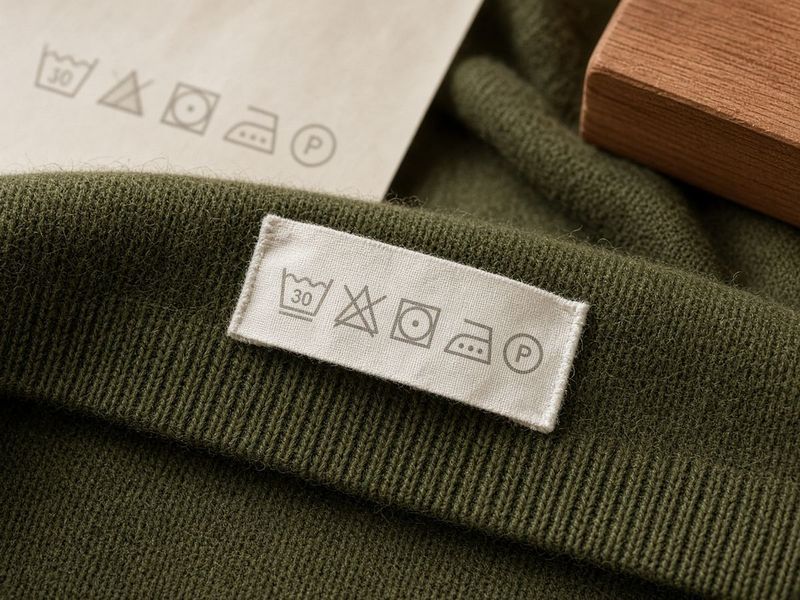
The five symbols, in the order they are printed
A modern care label is a GINETEX / ISO 3758 strip, not a suggestion from the brand’s merchandising team. Five pictograms run left to right: washtub, triangle, square, iron, circle. An X through any of them means do not. Dots mean heat. Bars under a symbol mean be gentler. That is the whole grammar.
The written line underneath (“machine wash cold, tumble dry low”) is a translation, and it is often more conservative than the pictograms. If the tub shows 40 and the English says cold, the fiber can take 40°C. The English is there for people who will sue over a slightly felted cuff. Treat the symbols as the specification and the sentence as the warranty.
Washtub, triangle, and the numbers that matter
The number in the tub is degrees Celsius, not Fahrenheit. 30 is a wool and darks default. 40 is most cotton. 60 is towels, sheets, and underwear you actually want clean. A hand in the tub is hand wash — soak and press, do not wring. No number and a filled tub usually means a normal machine cycle at the stated temp.
Bars under the tub cut agitation: one bar is a permanent-press / reduced cycle, two bars is delicate or wool. That two-bar 30°C cycle is what you want for merino; the full how-to lives in how to wash merino wool. The triangle is bleach. Empty triangle: any bleach, including chlorine. Triangle with two diagonal lines: oxygen / non-chlorine only (sodium percarbonate, OxiClean). X: no bleach of any kind, which is most wool, silk, and anything with spandex that chlorine will yellow.
| Symbol | Means | Ignore this at your peril |
|---|---|---|
| Tub + 30 / 40 / 60 | Max wash temperature in °C | 60°C on a Superwash sweater still felts the cuffs |
| Tub + one bar | Reduced agitation | Denim and oxford can take a normal cycle |
| Tub + two bars | Gentle / wool | The right default for knits |
| Empty triangle | Chlorine bleach allowed | Whites only; it wrecks elastic |
| Lined triangle | Oxygen bleach only | Safe on most colors if the stain is organic |
Square, iron dots, and the dry-clean circle
The square is drying. A circle inside it is a tumble dryer; dots inside that circle are heat (one dot low, two medium, three high). A square with a bar in the top third is line dry. A bar across the middle is drip dry. A horizontal bar in the lower third, or a curved line, is dry flat — knits, always. An X over the tumble-dry circle is the one people skip, then wonder why the viscose shirt is now a viscose crop.
Iron dots: one dot is 110°C (acrylic, acetate, nylon). Two is 150°C (wool, silk, polyester). Three is 200°C (cotton, linen). If you do not know, start at one dot with steam off.
The circle is professional cleaning. A is any solvent (older labels). P is perchloroethylene plus hydrocarbons — the standard “dry clean” most high-street shops run. F is hydrocarbon / petroleum solvents only, milder, used on acetate, some sequins, and trims that perc will melt. W is professional wet cleaning, which is water plus a trained machine, not your bathtub. A crossed circle means do not dry-clean; the piece wants water.
When “dry clean only” is a lawyer, not a fiber
A $45 100% cotton oxford that says dry clean only is protecting the maker from a 3% shrink claim, not describing physics. Cotton poplin, chambray, twill, and most jeans can go cold, low spin, hang dry. You will spend $4–8 per shirt at the cleaner for a service the fiber does not need. A $12 mesh bag and a 30°C cycle is the real care label.
Do not play this game with: viscose / rayon (it water-spots and slumps), a fused-canvas blazer, beaded or coated fabric, leather or suede trim, and anything with a lining that is a different fiber from the shell. Those labels are honest. On wool, read the two-bar tub before you pay a cleaner — untreated merino often wants a wool cycle or a hand wash, not perc. Stains are a separate problem; the label will not tell you how to lift coffee, which is why stain chemistry exists.
Pilling, moths, and agitation are also off-label. A correct wash will not stop bag-strap pills — see how to stop clothes pilling — and a dry-clean ticket will not kill keratin-eating larvae hiding in a knit. For that, prevent moths with wash, freeze, or a real clean, not a cedar block.
Questions, answered
- What does a P in a circle mean on a care label?
- Professional dry-clean in perchloroethylene or hydrocarbon solvents. It is the default “dry clean” mark. An F is stricter: hydrocarbons only, no perc.
- Can I wash something that says dry clean only?
- If it is 100% cotton or linen with no special finish, usually yes — cold, gentle, hang dry. If it is viscose, a structured jacket, or mixed with leather, no. The fiber content line is more useful than the English warning.
- Is the number in the washtub Fahrenheit?
- No. Care labels use Celsius worldwide. 30 is cool, 40 is warm, 60 is hot. 30°C is 86°F, not a cold-water US setting of 60°F.